
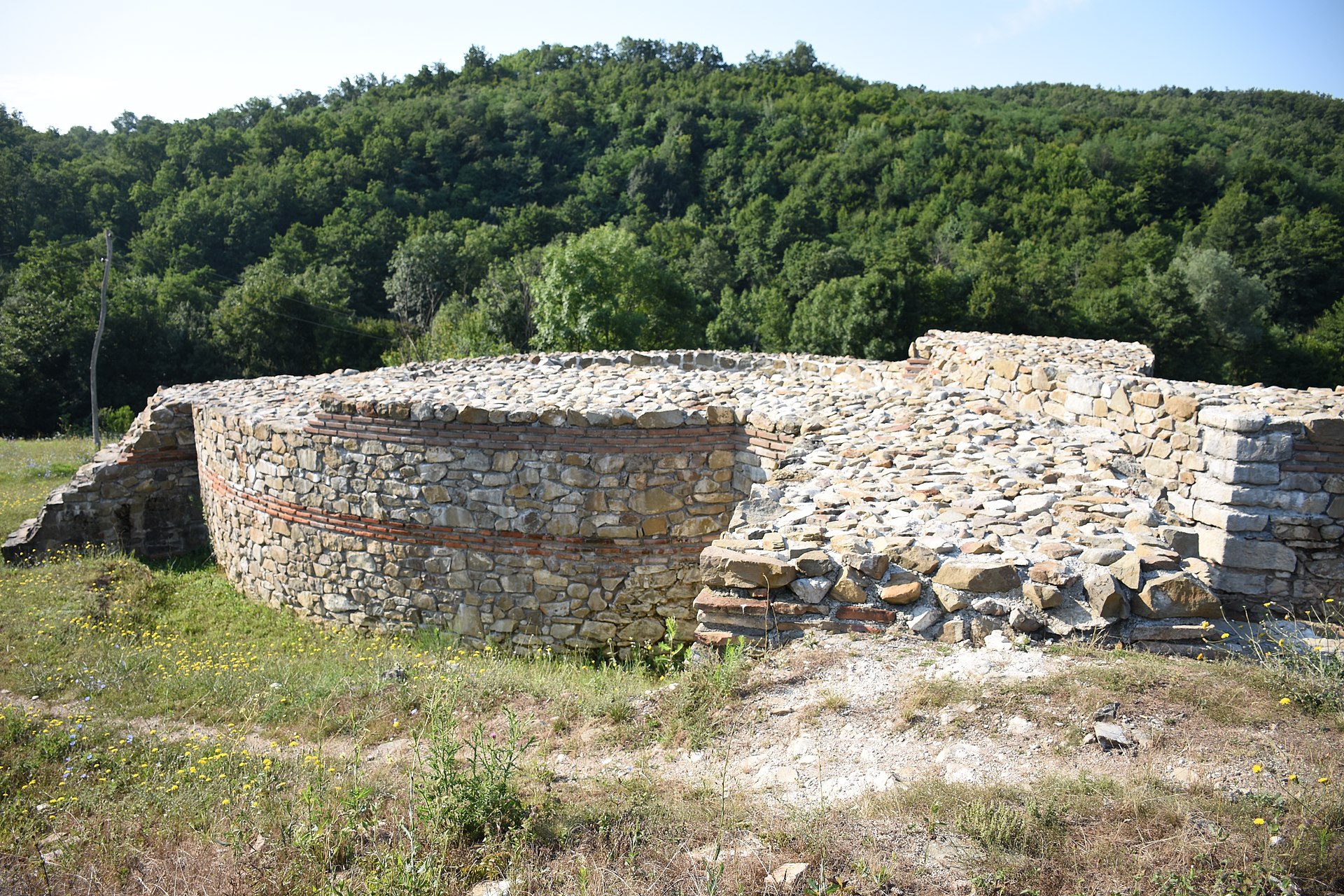
The Imperial Guard of Tsar Daja, near Negotin
The Roman site of Vrelo is located on the left bank of the Vrel River, 6 km west of the village of Šarkamen near Negotin. This locality was first noted by Felix Kanic in 1889, and the architect Đurđe Bošković sketched the visible objects in 1947: a fortification, a bridge and a temple on the left bank, and thermal baths on the right bank of the Vrelska River. The first archaeological research on Šarkamen was undertaken by the curators of the Krajina Museum in Negotin, Milica and Đorđe Janković, in 1975, when parts of the imperial porphyry sculpture were found. The researchers identified this precious stone statue as belonging to the Tetrarchy period, and they dated the fortification to early Byzantine times, in the 6th century.
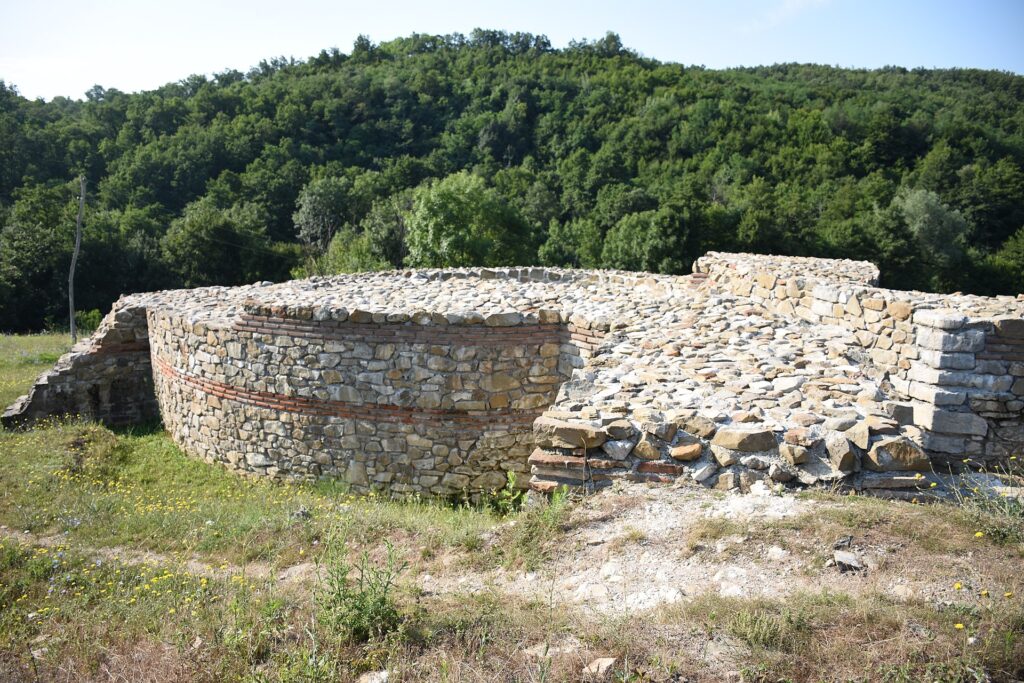
The late antique residential-memorial complex has a square base, dimensions 90 m x 90 m, but with walls made of stone and decorative rows of bricks, in the opus mihtum technique. The complex has ten towers, with an inner diameter of 9 m and an outer diameter of 15 m.
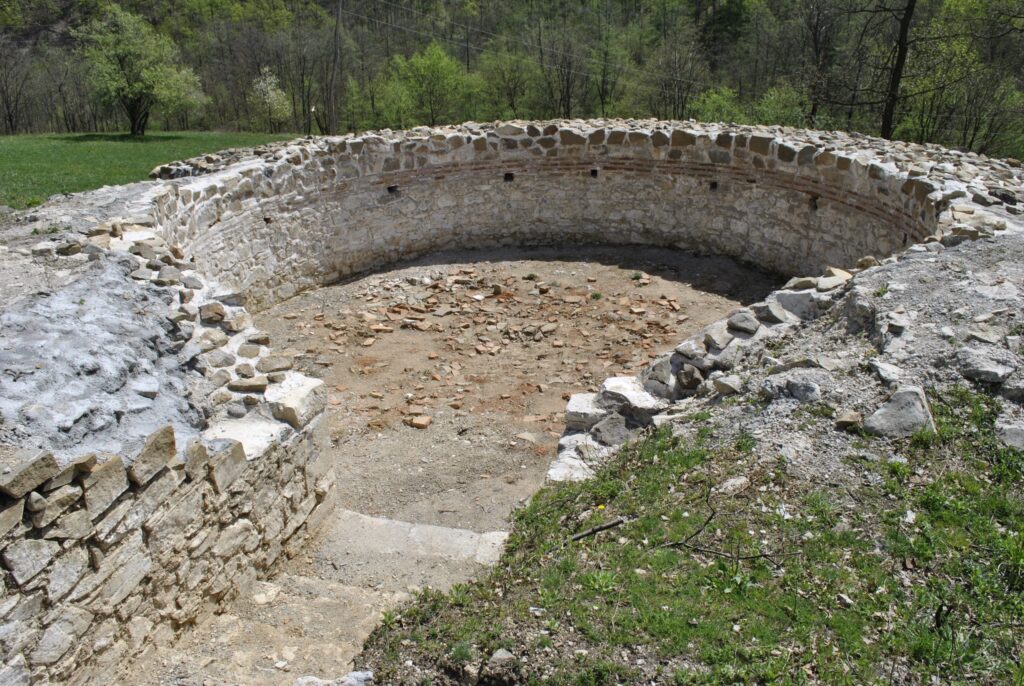
The same bricks with the stamps of the V Macedonian Legion (Legio V Macedonica) were used, which was stationed in Eskus (Oescus), today Gligen in northwestern Bulgaria, which, like Gamzigrad and Sarkamen, belonged to the late antique province of Coastal Dacia (Dacia Ripensis).
In the period from 1994 to 2003, SANU, the Archaeological Institute in Belgrade and the Krajina Museum in Negotin carried out systematic archaeological research of this site. Several buildings were discovered on the left and right banks of the Vrel river, among which the most important are the fortifications of the imperial residence and the memorial complex with the imperial mausoleum and consecratory tumulus.
In the mausoleum, the cremated remains of the empress were discovered with a set of personal gold jewelry, 3 necklaces, 3 rings, two earrings, a pendant and a pair of necklaces, total weight of about 250 grams. In addition to the set of gold jewelry with the remains of the cremated deceased, 9 votive plates made of gold sheet with embossed obverses of tetrarchy gold coins, aureus, on which the identifying names of the emperors Diocletian, Constantius Chlorus and Maximinus Daya were stored.
Based on the aforementioned research, the fort and the memorial complex are dated to the beginning of the 4th century and are attributed to the tetrarch Maximin Daya (305-313 AD), and the mausoleum to his mother, the sister of Emperor Galerius. Also, it was determined that the complex on Šarkamen was built towards the palace of the Emperor Felix Romuliana Gallery in Gamzigrad and the memorial-sacred complex on Magura, dedicated to the emperor and his mother Romula.
Vrelo-Šarkamen is an exclusive monument of Roman culture, and the gold jewelry from the mausoleum, which can be safely attributed to a woman from the imperial family, is a spectacular find, unique in the area of the Roman Empire.
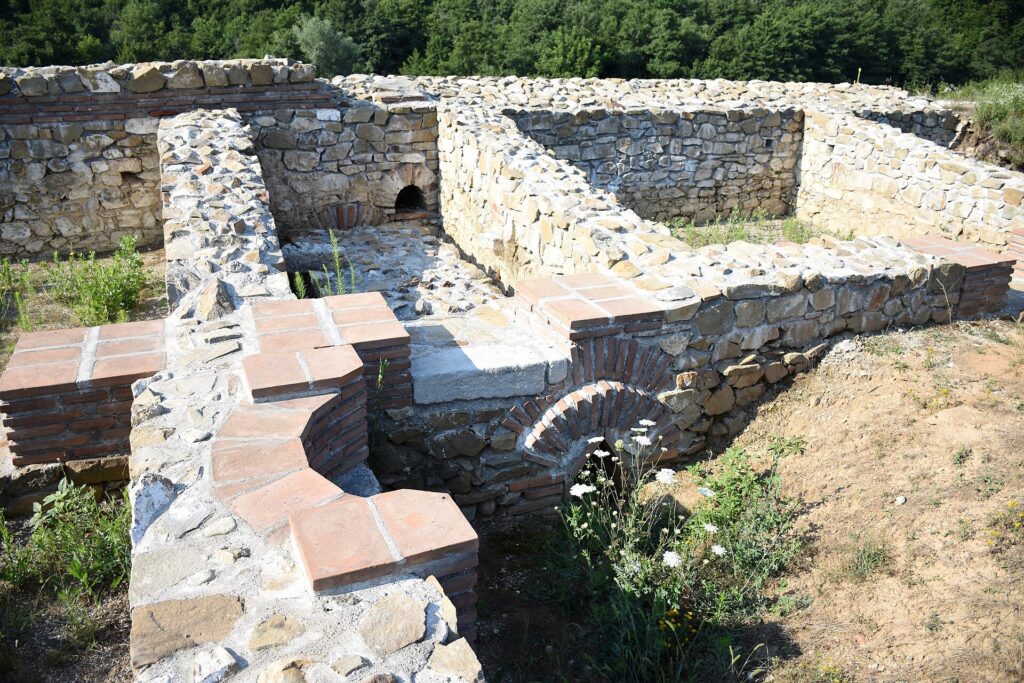
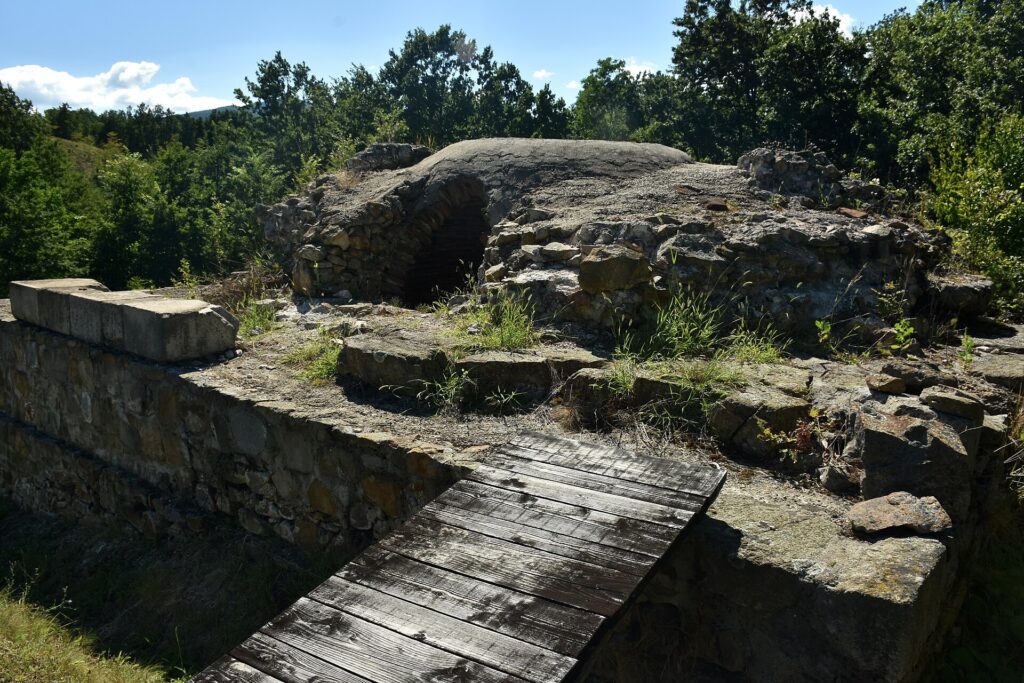
In three campaigns of archaeological excavations (2013-2015), attention was focused on two sectors of the fortified palace – the monumental south-eastern tower with a circular base (tower 8) and the western gate with the associated towers, of which the southern one is polygonal (tower 1) and the northern circular (tower 2). Conservation and restoration works were partially carried out in 2014 on the southeast tower, and in the same year its entrance was discovered, with a monumental staircase, a unique architectural solution in Roman fortification construction, as well as the remains of an older villa fortification (villa rustica), which preceded the construction of the imperial residences – a square tower with a part of the eastern and southern ramparts, integrated into the palace fortification. This necessitated the continuation of work in the southeastern part of the fortification, where in 2015 a water supply facility, a water tower – castellum aquae, with a system of supply and drainage channels and clarifiers was discovered along the southern rampart, west of the entrance to the southeastern tower. Water was brought to the fortified palace from the south, most likely by an aqueduct (aquaeduct), which bridged the valley of the Vrel river, perhaps from the source of this river from the cave, from Vrel. The reason for the construction of this aqueduct, in an environment that is rich in water and springs, should probably be sought in its healing properties, which were highly valued by the Romans. Given that Maximin Daya built a residence in his birthplace, following the example of other tetrarchs, he must have been aware of the beneficial properties of hot water. By the way, preserved Roman water supply facilities, water towers, are very rare, and in our country they were only discovered near the Mediana Palace, which was built in the 4th century by Emperor Constantine the Great in Niš and at Tsarica’s Town (Iustiniana Prima) near Lebano. the city and the archbishop’s seat, which was built in his homeland by Emperor Justinian I in the 6th century. In addition, the exterior of the southeastern tower, its connections with the eastern and southern ramparts and its central buttress, of unique construction, were discovered.
The research of this architectural complex, which is unique in the world, is important both for the archeology and history of our country and the wider Roman Empire, as well as for the development of cultural tourism in Negotinska Krajina and Serbia. Namely, archaeological excavations, followed by conservation and restoration work on architectural monuments, are a prerequisite for the presentation and promotion of the Roman site in Šarkamen, which was awarded the category of cultural property of great importance for the Republic of Serbia in 1994.